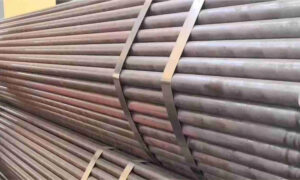
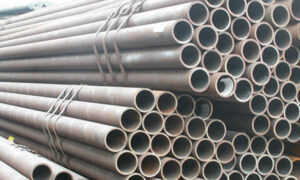
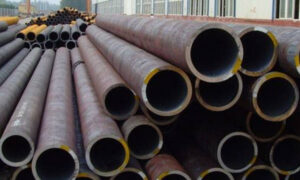
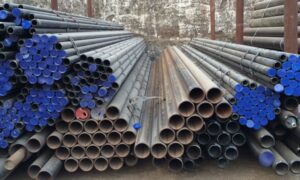
ASTM A335 P91 Pipe

High-Temperature & High-Creep Strength UNS K91560 Seamless Ferritic Alloy Steel P91 / IBR Pipes

Grade ASTM A335 Grade P91 / ASME SA335 Grade P91 (UNS K91560, 9Cr-1Mo-V, 1.4903, X10CrMoVNb9-1)
Standard ASTM A335, ASME SA335, ASTM A450, ASTM A530, ASME B36.10M, IBR (Indian Boiler Regulations), EN 10216-2, DIN 17175, JIS G3458
Stock Available
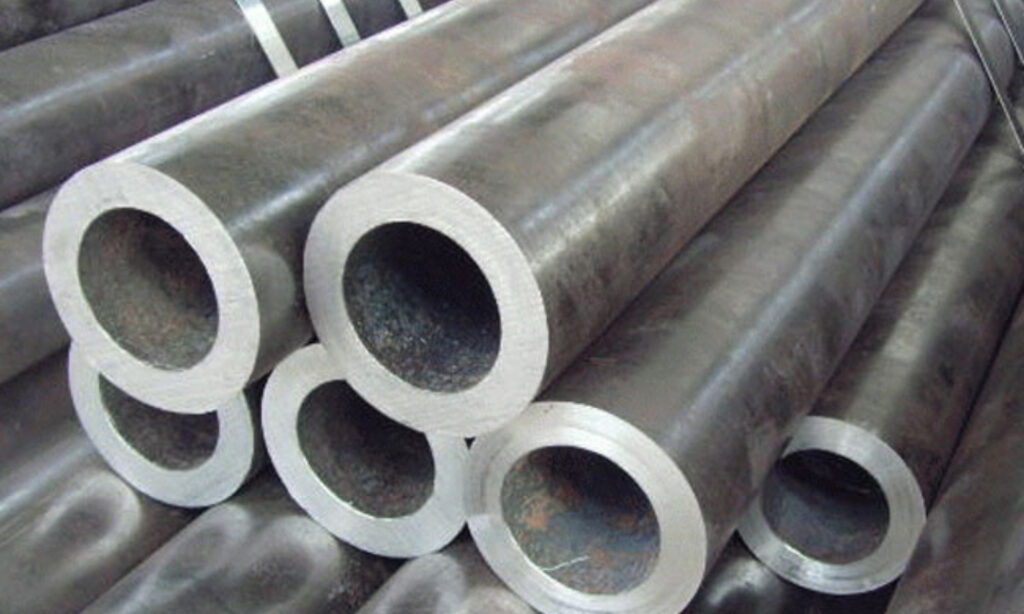
Home Raw Material Alloy Steel ASTM A335 P91 Pipe

Product Overview

Om Export India Pvt Ltd is a premier manufacturer, stockist, and global supplier of ASTM A335 P91 Alloy Steel Pipes (ASME SA335 Grade P91 / UNS K91560). Modified with 9% Chromium, 1% Molybdenum, and micro-alloyed additions of Vanadium (V), Niobium (Nb), and Nitrogen (N), ASTM A335 Grade P91 (9Cr-1Mo-V) represents an advanced martensitic-ferritic creep-strength enhanced alloy steel (CSEF) engineered specifically for critical high-temperature, supercritical, and ultra-supercritical power plant and refinery applications operating at service temperatures up to 600°C to 650°C.

The micro-alloyed vanadium and niobium form fine, stable carbonitrides within a tempered martensitic matrix that dramatically boost creep-rupture strength, allowing designers to utilize significantly thinner wall pipe schedules compared to older P11 or P22 installations. This reduces component thermal stress, decreases total piping weight, minimizes pre-heating/welding cycle times, and provides robust scaling and thermal oxidation resistance. All our P91 seamless pipes strictly meet ASME Section II, ASTM A530, and Indian Boiler Regulations (IBR) standards with strict control over normalizing and tempering parameters.

  • Enhanced Creep Strength: Micro-alloyed with V and Nb to provide exceptional high-temperature stress rupture longevity up to 600°C.
  • Reduced Wall Thickness: Superior tensile properties allow reduced wall dimensions, decreasing thermal fatigue under rapid cycling.
  • IBR & NACE Certified: Fully certified under Indian Boiler Regulations (Form III-A / Form III-C) and NACE MR0175 for severe service.

Key Features

  • Creep Rupture Longevity: High stress-rupture strength at continuous operating temperatures up to 600°C.
  • Optimized Wall Thickness: High yield strength reduces wall thickness and reduces overall piping deadweight.
  • Thermal Fatigue Resistance: Thinner walls minimize thermal gradients during start-ups and shutdowns.
  • Corrosion & Oxidation Protection: 9% Chromium matrix protects against hot steam scaling, sulfurous gases, and oxidation.
  • Microstructural Stability: Stable precipitates (M23C6 carbides and MX carbonitrides) prevent grain growth and graphitization.
  • Comprehensive Surface Coatings: Available in mill varnish, 3LPE, FBE, light rust-preventative oil, or bare finish.

Product Specifications

Parameter Standard Specification / Technical Value
Nominal Size Range 1/8" NB to 36" NB (10.29 mm to 914.4 mm Outer Diameter)
Wall Thickness / Schedules SCH 40, SCH 80, SCH 160, SCH XS, SCH XXS, Heavy Wall (3.0 mm up to 60.0 mm WT)
Manufacturing Methods Hot Finished Seamless, Cold Drawn Seamless (CDS), Precision Cold Rolled
Heat Treatment Normalize at 1900°F–1975°F (1040°C–1080°C) + Subcritical Temper at 1350°F–1470°F (730°C–800°C)
Length Parameters Single Random, Double Random, Standard 6m / 12m, Custom Cut Lengths up to 26,000 mm
End Configurations Plain End (PE), Beveled End (BE per ASME B16.25), Threaded & Coupled (NPT)
Max Operating Temperature Continuous service up to 1112°F (600°C – 650°C)
Testing & Compliance IBR Approved, 100% NDT (UT & Eddy Current), NACE MR0175/ISO 15156, EN 10204 3.1 & 3.2

Dimensions & Sizes

Nominal Pipe Size (NPS) Outside Diameter (OD in / mm) Wall Thickness (WT in / mm) Inside Diameter (ID in / mm) Nominal Weight (lb/ft / kg/m)
1/2" NB (SCH 40 / STD) 0.840" (21.34 mm) 0.109" (2.77 mm) 0.622" (15.80 mm) 0.85 lb/ft (1.27 kg/m)
1/2" NB (SCH 80 / XS) 0.840" (21.34 mm) 0.147" (3.73 mm) 0.546" (13.88 mm) 1.09 lb/ft (1.62 kg/m)
1/2" NB (SCH 160) 0.840" (21.34 mm) 0.188" (4.78 mm) 0.464" (11.78 mm) 1.31 lb/ft (1.95 kg/m)
3/4" NB (SCH 40 / STD) 1.050" (26.67 mm) 0.113" (2.87 mm) 0.824" (20.93 mm) 1.13 lb/ft (1.68 kg/m)
3/4" NB (SCH 80 / XS) 1.050" (26.67 mm) 0.154" (3.91 mm) 0.742" (18.85 mm) 1.48 lb/ft (2.20 kg/m)
1" NB (SCH 40 / STD) 1.315" (33.40 mm) 0.133" (3.38 mm) 1.049" (26.64 mm) 1.68 lb/ft (2.50 kg/m)
1" NB (SCH 80 / XS) 1.315" (33.40 mm) 0.179" (4.55 mm) 0.957" (24.30 mm) 2.17 lb/ft (3.23 kg/m)
1" NB (SCH 160) 1.315" (33.40 mm) 0.250" (6.35 mm) 0.815" (20.70 mm) 2.85 lb/ft (4.24 kg/m)
1-1/2" NB (SCH 40 / STD) 1.900" (48.26 mm) 0.145" (3.68 mm) 1.610" (40.90 mm) 2.72 lb/ft (4.05 kg/m)
1-1/2" NB (SCH 80 / XS) 1.900" (48.26 mm) 0.200" (5.08 mm) 1.500" (38.10 mm) 3.63 lb/ft (5.40 kg/m)
2" NB (SCH 40 / STD) 2.375" (60.33 mm) 0.154" (3.91 mm) 2.067" (52.51 mm) 3.66 lb/ft (5.45 kg/m)
2" NB (SCH 80 / XS) 2.375" (60.33 mm) 0.218" (5.54 mm) 1.939" (49.25 mm) 5.03 lb/ft (7.49 kg/m)
2" NB (SCH 160) 2.375" (60.33 mm) 0.344" (8.74 mm) 1.687" (42.85 mm) 7.47 lb/ft (11.12 kg/m)
3" NB (SCH 40 / STD) 3.500" (88.90 mm) 0.216" (5.49 mm) 3.068" (77.92 mm) 7.58 lb/ft (11.29 kg/m)
3" NB (SCH 80 / XS) 3.500" (88.90 mm) 0.300" (7.62 mm) 2.900" (73.66 mm) 10.26 lb/ft (15.27 kg/m)
3" NB (SCH 160) 3.500" (88.90 mm) 0.438" (11.13 mm) 2.624" (66.64 mm) 14.34 lb/ft (21.35 kg/m)
4" NB (SCH 40 / STD) 4.500" (114.30 mm) 0.237" (6.02 mm) 4.026" (102.26 mm) 10.80 lb/ft (16.08 kg/m)
4" NB (SCH 80 / XS) 4.500" (114.30 mm) 0.337" (8.56 mm) 3.826" (97.18 mm) 15.00 lb/ft (22.32 kg/m)
4" NB (SCH 160) 4.500" (114.30 mm) 0.531" (13.49 mm) 3.438" (87.32 mm) 22.53 lb/ft (33.54 kg/m)
6" NB (SCH 40 / STD) 6.625" (168.28 mm) 0.280" (7.11 mm) 6.065" (154.06 mm) 18.99 lb/ft (28.26 kg/m)
6" NB (SCH 80 / XS) 6.625" (168.28 mm) 0.432" (10.97 mm) 5.761" (146.34 mm) 28.60 lb/ft (42.56 kg/m)
6" NB (SCH 160) 6.625" (168.28 mm) 0.719" (18.26 mm) 5.187" (131.76 mm) 45.39 lb/ft (67.56 kg/m)

Chemical Composition

Element ASTM A335 / ASME SA335 Grade P91 Composition (%)
Carbon (C) 0.08 – 0.12
Manganese (Mn) 0.30 – 0.60
Phosphorus (P, Max) 0.020
Sulfur (S, Max) 0.010
Silicon (Si) 0.20 – 0.50
Chromium (Cr) 8.00 – 9.50
Molybdenum (Mo) 0.85 – 1.05
Vanadium (V) 0.18 – 0.25
Nitrogen (N) 0.030 – 0.070
Nickel (Ni, Max) 0.40
Aluminum (Al, Max) 0.040
Niobium / Columbium (Nb) 0.06 – 0.10

Mechanical Properties

Mechanical Property Specified Standard Value (ASTM A335 P91 / UNS K91560)
Tensile Strength (Min) 585 MPa (85 ksi)
Yield Strength (0.2% Offset, Min) 415 MPa (60 ksi)
Elongation in 2 inches / 50 mm (Min) Longitudinal: 20% Min | Transverse: 15% Min
Hardness (Brinell / Rockwell) 190 to 250 HBW Max (Approx. 25 HRC Max)
Impact Strength (Charpy V-Notch) ≥ 40 J at Room Temperature (20°C)
Flattening & Bend Test Satisfies ASTM A530 with zero cracking or micro-fissuring

Standards & Specifications

Standard Designation Governing Body / Region Grade / Equivalent Designation
ASTM A335 / ASME SA335 ASTM / ASME (USA) Grade P91 (UNS K91560)
EN 10216-2 / DIN 17175 European Union / Germany 1.4903 / X10CrMoVNb9-1
JIS G3458 Japanese Industrial Standards STPA 28
BS 3604 British Standards Grade 762
Indian Boiler Regulations (IBR) Central Boilers Board (India) IBR Certified SA335 P91
ASME Boiler Code Section II ASME BPV Committee SA335 Grade P91 Table 1A Allowable Stress

Applications

ASTM A335 P91 Chrome-Moly alloy pipes are deployed across severe-duty thermal, power generation, and refining systems:

  • Supercritical & Ultra-Supercritical Boilers: Main steam lines, high-temperature reheat piping, superheater coils, and boiler headers.
  • Combined Cycle Gas Turbine (CCGT) Plants: Heat Recovery Steam Generator (HRSG) high-pressure steam conduits and transfer piping.
  • Petrochemical & Hydroprocessing Plants: High-pressure, high-temperature hydrogen service lines, reformer headers, and coking units.
  • Thermal Power Stations: Steam bypass headers, turbine inlet steam lines, and auxiliary steam loops under IBR regulations.
  • Nuclear & High-Pressure Utility Stations: High-integrity process lines demanding high thermal creep resistance and fatigue mitigation.

Frequently Asked Questions

Q1: Why is ASTM A335 P91 preferred over ASTM A335 P22 in modern steam lines?
P91 provides more than double the creep-rupture strength of P22 at temperatures around 550°C–600°C. This allows engineers to design steam lines with significantly thinner pipe walls, reducing weight by up to 50%, mitigating thermal fatigue during start-stop cycling, and reducing structural support requirements.

Q2: What heat treatment is mandatory for ASTM A335 P91 pipes?
P91 requires a controlled two-stage heat treatment: normalizing at 1040°C–1080°C (1900°F–1975°F) followed by air cooling to convert the microstructure to full martensite, and subsequent tempering at 730°C–800°C (1350°F–1470°F) to achieve the required ductility and maintain hardness under 250 HBW.

Q3: Why is maximum hardness restricted to 250 HBW for Grade P91?
Restricting hardness to a maximum of 250 HBW (approx. 25 HRC) ensures adequate fracture toughness and mitigates susceptibility to stress corrosion cracking (SCC) and hydrogen-assisted cold cracking in high-stress steam and sour environments.

Q4: Can Om Export India Pvt Ltd provide IBR Form III-A certificates for P91 pipes?
Yes, all P91 piping supplies can be accompanied by complete IBR Form III-A or Form III-C certificates stamped and endorsed by the Indian Boiler Regulations Directorate along with standard EN 10204 3.1/3.2 MTCs.

Looking For Reliable Industrial Material Supply?

Contact OM Export India for pricing, technical support, stock availability and export enquiries.

×

Download Company Profile