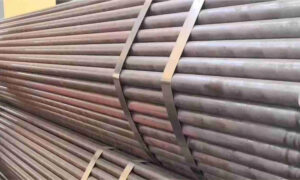
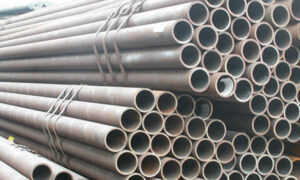
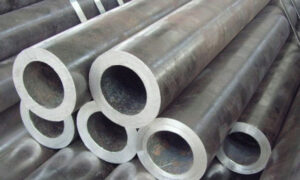
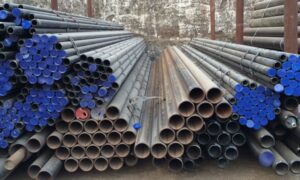
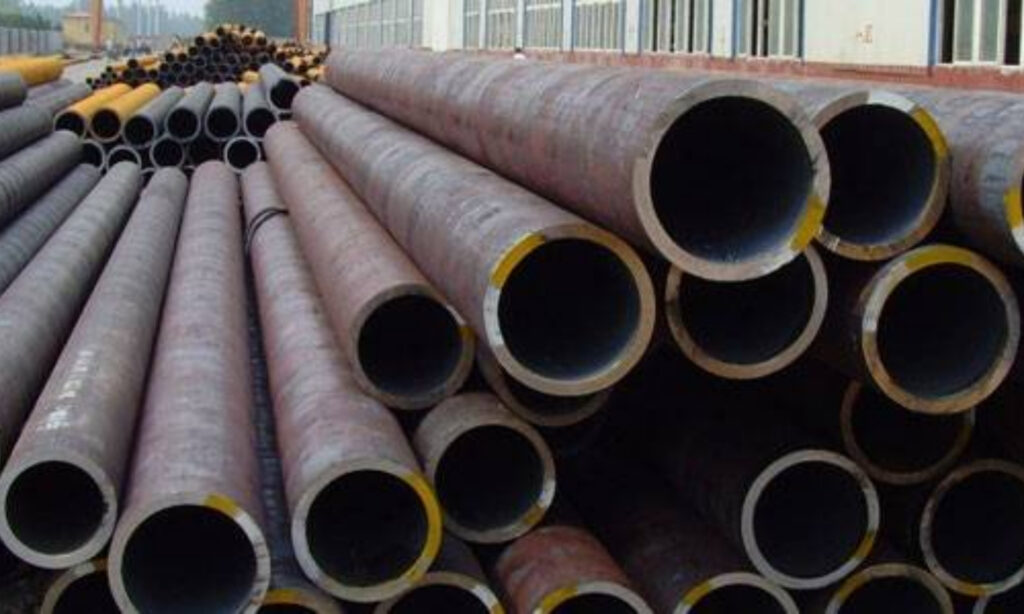
ASTM A335 P22 Pipe (ASME SA335 Grade P22 Chrome Moly Alloy Steel Pipe)

High-Pressure & High-Temperature Ferritic Low Alloy Steel P22 Seamless Pipes & IBR Tubes

Grade ASTM A335 Grade P22 / ASME SA335 Grade P22 (UNS K21590, 2.25Cr-1Mo, 10CrMo9-10)
Standard ASTM A335, ASME SA335, ASTM A450, ASTM A530, ASME B36.10M, IBR (Indian Boiler Regulations), EN 10216-2, DIN 17175, JIS G3458
Stock Available
Home Raw Material Alloy Steel ASTM A335 P22 Pipe (ASME SA335 Grade P22 Chrome Moly Alloy Steel Pipe)

Product Overview

Om Export India Pvt Ltd is an industry-leading manufacturer, stockist, and global supplier of ASTM A335 P22 High-Pressure Alloy Steel Pipes (ASME SA335 Grade P22 / UNS K21590). Engineered from a 2.25% Chromium – 1% Molybdenum nominal alloy matrix, ASTM A335 Grade P22 is a premium ferritic low-alloy steel designed specifically for high-temperature header lines, superheater coils, steam power piping, and high-pressure petrochemical process infrastructure operating up to 590°C (1094°F).

The addition of Chromium enhances oxidation resistance, tensile strength, and scaling prevention under sustained thermal conditions, while Molybdenum provides superior creep resistance, temper-embrittlement mitigation, and high rupture strength. Fully compliant with ASME B36.10, ASTM A530, and Indian Boiler Regulations (IBR), our seamless P22 chrome-moly pipes are heat treated via full annealing, isothermal annealing, or normalizing followed by tempering at a minimum of 1250°F (675°C).

  • Creep & Thermal Resistance: Engineered to withstand sustained thermal and high-pressure mechanical stresses without structural deformation or graphitization.
  • IBR Certified: Available with complete Form III-A / III-D Indian Boiler Regulation approvals for utility boiler headers and steam loops.
  • Fabrication & Bending: Excellent ductility and formability suitable for hot/cold induction bending, swaging, and fusion welding.

Key Features

  • High Creep Rupture Strength: Engineered for sustained performance under high cyclic thermal stress.
  • Oxidation & Corrosion Resistance: 2.25% Chromium formulation resists hot scaling, flue gases, and atmospheric oxidation.
  • Severe-Pressure Capability: Heavy-wall seamless integrity eliminates weld weaknesses in extreme pressure lines.
  • Dimensional Precision: Strict adherence to ASTM A450 and ASTM A530 outer diameter and wall thickness tolerances.
  • Thermal Stability: Resists graphitization, grain coarsening, and structural degradation at temperatures up to 1094°F (590°C).
  • Custom Protective Finishes: Mill varnish, 3LPE, 3LPP, FBE, Galvanized, and bare anti-rust coatings.

Product Specifications

Parameter Standard Specification / Technical Value
Nominal Size Range 1/2" NB to 36" NB (21.34 mm to 914.4 mm Outer Diameter)
Wall Thickness / Schedules SCH 40, SCH 80, SCH 160, SCH XS, SCH XXS, Heavy Wall (3.0 mm up to 60.0 mm WT)
Manufacturing Methods Hot Finished Seamless, Cold Drawn Seamless (CDS), Precision Cold Rolled
Heat Treatment Full Annealed, Isothermal Annealed, or Normalized & Tempered (Min Tempering: 1250°F / 675°C)
Length Parameters Single Random Length (SRL), Double Random Length (DRL), Cut Lengths up to 16,000 mm / 26,000 mm
End Configurations Plain End (PE), Beveled End (BE 30° / 37.5° per ASME B16.25), Threaded & Coupled (NPT)
Maximum Service Temperature Continuous service up to 1094°F (590°C)
Certifications Available IBR (Form III-C/III-A), NACE MR0175/ISO 15156, EN 10204 Type 3.1 & 3.2

Dimensions & Sizes

Nominal Pipe Size (NPS) Outside Diameter (OD in / mm) Wall Thickness (WT in / mm) Inside Diameter (ID in / mm) Nominal Weight (lb/ft / kg/m)
1/2" NB (SCH 40 / STD) 0.840" (21.34 mm) 0.109" (2.77 mm) 0.622" (15.80 mm) 0.85 lb/ft (1.27 kg/m)
1/2" NB (SCH 80 / XS) 0.840" (21.34 mm) 0.147" (3.73 mm) 0.546" (13.88 mm) 1.09 lb/ft (1.62 kg/m)
1/2" NB (SCH 160) 0.840" (21.34 mm) 0.188" (4.78 mm) 0.464" (11.78 mm) 1.31 lb/ft (1.95 kg/m)
3/4" NB (SCH 40 / STD) 1.050" (26.67 mm) 0.113" (2.87 mm) 0.824" (20.93 mm) 1.13 lb/ft (1.68 kg/m)
3/4" NB (SCH 80 / XS) 1.050" (26.67 mm) 0.154" (3.91 mm) 0.742" (18.85 mm) 1.48 lb/ft (2.20 kg/m)
1" NB (SCH 40 / STD) 1.315" (33.40 mm) 0.133" (3.38 mm) 1.049" (26.64 mm) 1.68 lb/ft (2.50 kg/m)
1" NB (SCH 80 / XS) 1.315" (33.40 mm) 0.179" (4.55 mm) 0.957" (24.30 mm) 2.17 lb/ft (3.23 kg/m)
1" NB (SCH 160) 1.315" (33.40 mm) 0.250" (6.35 mm) 0.815" (20.70 mm) 2.85 lb/ft (4.24 kg/m)
1-1/2" NB (SCH 40 / STD) 1.900" (48.26 mm) 0.145" (3.68 mm) 1.610" (40.90 mm) 2.72 lb/ft (4.05 kg/m)
1-1/2" NB (SCH 80 / XS) 1.900" (48.26 mm) 0.200" (5.08 mm) 1.500" (38.10 mm) 3.63 lb/ft (5.40 kg/m)
2" NB (SCH 40 / STD) 2.375" (60.33 mm) 0.154" (3.91 mm) 2.067" (52.51 mm) 3.66 lb/ft (5.45 kg/m)
2" NB (SCH 80 / XS) 2.375" (60.33 mm) 0.218" (5.54 mm) 1.939" (49.25 mm) 5.03 lb/ft (7.49 kg/m)
2" NB (SCH 160) 2.375" (60.33 mm) 0.344" (8.74 mm) 1.687" (42.85 mm) 7.47 lb/ft (11.12 kg/m)
3" NB (SCH 40 / STD) 3.500" (88.90 mm) 0.216" (5.49 mm) 3.068" (77.92 mm) 7.58 lb/ft (11.29 kg/m)
3" NB (SCH 80 / XS) 3.500" (88.90 mm) 0.300" (7.62 mm) 2.900" (73.66 mm) 10.26 lb/ft (15.27 kg/m)
3" NB (SCH 160) 3.500" (88.90 mm) 0.438" (11.13 mm) 2.624" (66.64 mm) 14.34 lb/ft (21.35 kg/m)
4" NB (SCH 40 / STD) 4.500" (114.30 mm) 0.237" (6.02 mm) 4.026" (102.26 mm) 10.80 lb/ft (16.08 kg/m)
4" NB (SCH 80 / XS) 4.500" (114.30 mm) 0.337" (8.56 mm) 3.826" (97.18 mm) 15.00 lb/ft (22.32 kg/m)
4" NB (SCH 160) 4.500" (114.30 mm) 0.531" (13.49 mm) 3.438" (87.32 mm) 22.53 lb/ft (33.54 kg/m)
6" NB (SCH 40 / STD) 6.625" (168.28 mm) 0.280" (7.11 mm) 6.065" (154.06 mm) 18.99 lb/ft (28.26 kg/m)
6" NB (SCH 80 / XS) 6.625" (168.28 mm) 0.432" (10.97 mm) 5.761" (146.34 mm) 28.60 lb/ft (42.56 kg/m)
6" NB (SCH 160) 6.625" (168.28 mm) 0.719" (18.26 mm) 5.187" (131.76 mm) 45.39 lb/ft (67.56 kg/m)

Chemical Composition

Element ASTM A335 / ASME SA335 Grade P22 Composition (%)
Carbon (C) 0.05 – 0.15
Manganese (Mn) 0.30 – 0.60
Phosphorus (P, Max) 0.025
Sulfur (S, Max) 0.025
Silicon (Si, Max) 0.50
Chromium (Cr) 1.90 – 2.60
Molybdenum (Mo) 0.87 – 1.13

Mechanical Properties

Mechanical Property Specified Limit (ASTM A335 P22 / UNS K21590)
Tensile Strength (Min) 415 MPa (60,000 psi / 60 ksi)
Yield Strength (0.2% Offset, Min) 205 MPa (30,000 psi / 30 ksi)
Elongation in 2 inches / 50 mm (Min) Longitudinal: 30% | Transverse: 20%
Hardness (Brinell / Rockwell, Max) 163 HBW Max (approx. 85 HRB Max)
Flattening Test No evidence of cracking or laminations when compressed per ASTM A530
Bend Test Passes 180° cold bend around mandatory mandrel diameter

Standards & Specifications

Standard System Equivalent Specification / Grade Standard Scope
ASTM / ASME ASTM A335 P22 / ASME SA335 P22 Seamless Ferritic Alloy-Steel Pipe for High-Temperature Service
UNS Number UNS K21590 Unified Numbering System for 2-1/4Cr-1Mo Low Alloy Steel
Indian Standard (IBR) IBR Certified P22 / IS 2825 Indian Boiler Regulations Approved Pressure Piping Systems
DIN / EN Standard DIN 17175 / EN 10216-2 (10CrMo9-10 / 1.7380) Seamless Steel Tubes for Elevated Temperatures and Pressures
Japanese Standard (JIS) JIS G3458 STPA 24 Alloy Steel Pipes for High-Temperature Service
British Standard (BS) BS 3604 Part 1 Grade 622 Steel Pipes and Tubes for Pressure Purposes: Ferritic Alloy Steel
Marine Classification ABS / LRS / DNV / NKK Approved Certified Marine Steam and Thermal Piping Systems

Applications

ASTM A335 P22 low-alloy chrome-moly pipes are selected for critical, severe-service thermal utilities and refining operations:

  • Thermal & Nuclear Power Plants: Main steam lines, boiler superheaters, reheater piping circuits, economizer headers, and bypass lines.
  • Petrochemical & Refinery Units: Hydrocracking loops, coking plants, catalytic cracking headers, and high-temperature gas processing pipelines.
  • Boiler & Pressure Vessel Fabrication: High-pressure steam drums, heat exchanger shells, feed piping, and transfer headers under IBR regulation.
  • Oil & Gas Infrastructure: High-pressure gas discharge lines, offshore manifold headers, and high-temperature furnace tube connections.
  • Industrial Heat Exchangers: High-temperature steam condensor coils, vapor lines, and heat recovery steam generators (HRSG).

Frequently Asked Questions

Q1: What is the primary difference between ASTM A335 P11, P22, and P91 pipes?
P11 contains 1.25% Cr and 0.5% Mo, P22 contains 2.25% Cr and 1.0% Mo, and P91 contains 9% Cr, 1% Mo, plus Vanadium and Nitrogen. P22 provides significantly higher creep strength, elevated thermal tolerance (up to 590°C), and superior hydrogen resistance compared to P11, making it the standard choice for main steam transfer.

Q2: Why is Post Weld Heat Treatment (PWHT) necessary for ASTM A335 P22 piping?
Due to its high chromium and molybdenum content, P22 has high hardenability. PWHT (typically between 675°C to 750°C) is mandatory to relieve residual welding stresses, restore ductility, and prevent hydrogen-induced cracking in heat-affected zones (HAZ).

Q3: What does IBR certification entail for ASTM A335 P22 pipes?
IBR (Indian Boiler Regulations) certification ensures that the material, melt heat, dimensional tolerance, non-destructive testing, and hydrostatic testing have been officially witnessed, verified, and certified under Form III-A or Form III-C for legal installation in high-pressure steam boilers.

Q4: Can ASTM A335 P22 seamless pipes be cold formed or induction bent?
Yes, in the fully annealed or normalized and tempered condition, P22 exhibits high elongation (≥30%), permitting cold flanging, tight radius cold bending, and hot induction bending followed by proper post-forming heat treatment.

Looking For Reliable Industrial Material Supply?

Contact OM Export India for pricing, technical support, stock availability and export enquiries.

×

Download Company Profile