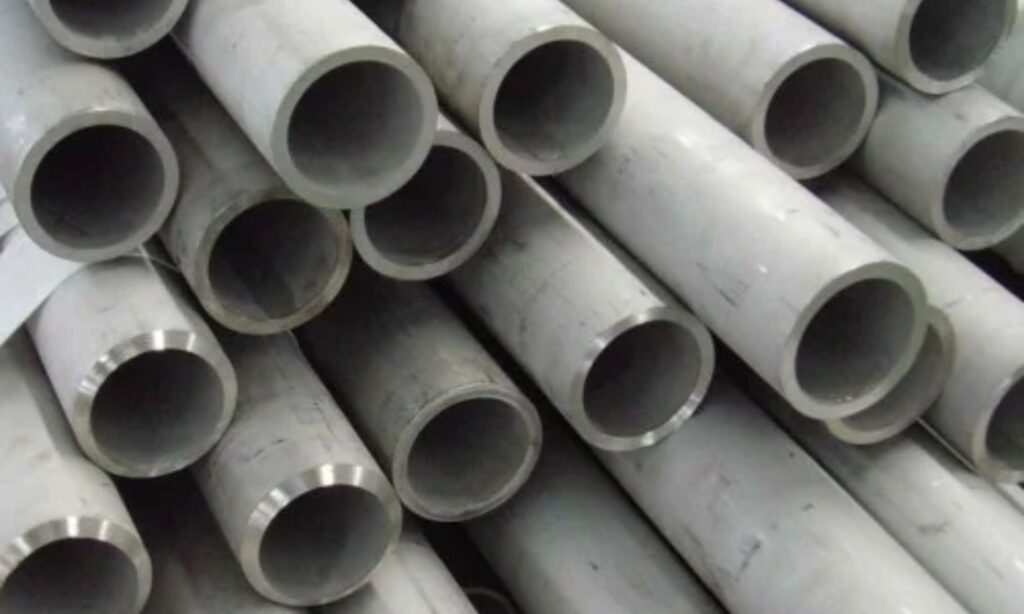
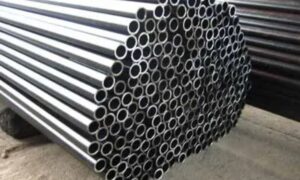
Titanium-Stabilized Austenitic Stainless Steel Seamless, Welded & ERW Pipes, Exhaust Tubing, and Boiler Tubes
Om Export India Pvt Ltd is an internationally recognized manufacturer, stockist, and global exporter of high-temperature Stainless Steel 321 Pipes and Tubes (ASTM A312 TP321 / UNS S32100 / Werkstoff 1.4541). Grade 321 is a stabilized austenitic chromium-nickel stainless steel containing an intentional addition of Titanium at a minimum concentration of five times the carbon plus nitrogen content [Ti ≥ 5 × (C + N)]. This metallurgical stabilization binds carbon as harmless titanium carbides (TiC), completely suppressing chromium carbide precipitation at grain boundaries and granting exceptional immunity to intergranular corrosion during prolonged exposure within the carbide precipitation temperature range of 427°C to 816°C (800°F to 1500°F).
Engineered for high-temperature and high-stress environments, our SS 321 seamless, welded, and ERW pipes meet ASTM A312, ASTM A213, ASTM A358, and Indian Boiler Regulations (IBR) standards. Operating with a density of 8.027 g/cm³ and a melting range of 1398°C to 1446°C, Grade 321 delivers superior short-term tensile and long-term creep-rupture performance up to 870°C (1600°F). These pipes and tubes are essential across aircraft exhaust manifolds, jet engine components, furnace flue gas ducts, expansion bellows, chemical processing reactors, and thermal boiler pipelines.
| Specification Parameter | Standard Specification / Technical Value |
|---|---|
| Nominal Size Range (Seamless) | 1/8" NB to 24" NB (Outer Diameter: 6.00 mm to 609.6 mm OD) |
| Nominal Size Range (Welded / ERW / EFW) | 1/8" NB to 48" NB (Outer Diameter: 6.00 mm to 1219.2 mm OD / Custom up to 100") |
| Wall Thickness & Schedules | 0.30 mm to 50.0 mm (SCH 5S, SCH 10S, SCH 40S/STD, SCH 80S/XS, SCH 160, SCH XXS) |
| Governing Standards | ASTM A312 / ASME SA312, ASTM A213, ASTM A269, ASTM A249, ASTM A358, ASTM A376, ASTM A409 |
| Manufacturing Methods | Cold Drawn Seamless (CDS), Hot Finished Seamless, High-Frequency Induction ERW, Plasma/TIG Welded, LSAW |
| Heat Treatment & Delivery State | Solution Annealed at 980°C – 1065°C followed by water quenching or rapid air cooling; Stabilizing Anneal available |
| Standard Lengths | Single Random Length (SRL), Double Random Length (DRL), Custom Cut Lengths up to 26,000 mm (26m) |
| End Configurations & Protection | Plain Square Cut End (PE), Beveled End (BE 30°/37.5° per ASME B16.25), Threaded Ends with Protective Plastic Caps |
| Element | ASTM A312 TP321 (%) | UNS S32100 (%) | DIN 1.4541 / X6CrNiTi18-10 (%) |
|---|---|---|---|
| Carbon (C, Max) | 0.08 | 0.08 | 0.08 |
| Chromium (Cr) | 17.00 – 19.00 | 17.00 – 19.00 | 17.00 – 19.00 |
| Nickel (Ni) | 9.00 – 12.00 | 9.00 – 12.00 | 9.00 – 12.00 |
| Titanium (Ti) | 5 × (C + N) Min – 0.70 Max | 5 × (C + N) Min – 0.70 Max | 5 × C Min – 0.70 Max |
| Manganese (Mn, Max) | 2.00 | 2.00 | 2.00 |
| Silicon (Si, Max) | 0.75 (1.00 Max) | 1.00 | 1.00 |
| Phosphorus (P, Max) | 0.045 | 0.045 | 0.045 |
| Sulfur (S, Max) | 0.030 | 0.030 | 0.015 |
| Nitrogen (N, Max) | 0.10 | 0.10 | — |
| Iron (Fe) | Balance | Balance | Balance |
| Mechanical Property | ASTM A312 TP321 Specified Limits | Typical Production Values |
|---|---|---|
| Tensile Strength, Ultimate (Min) | 515 MPa (75 ksi / 75,000 psi) | 550 – 630 MPa |
| Yield Strength (0.2% Proof, Min) | 205 MPa (30 ksi / 30,000 psi) | 230 – 290 MPa |
| Elongation in 2 in. / 50 mm (Min) | 35% – 40% Min | 45% – 55% |
| Hardness (Rockwell B / Brinell, Max) | 95 HRB Max / 217 HBW Max | 80 – 88 HRB (150 – 185 HBW) |
| Density & Melting Range | Density: 8.027 g/cm³ (8027 kg/m³) | Melting Range: 1398°C – 1446°C (2550°F – 2635°F) |
| Modulus of Elasticity (Tension) | 193 GPa (28 x 10⁶ psi) | Electrical Resistivity: 720 nΩ·m |
| Thermal Expansion (0–100°C / 0–538°C) | 16.6 µm/m·°C (0–100°C) | 18.6 µm/m·°C (0–538°C) |
| Thermal Conductivity & Specific Heat | 16.1 W/m·K at 100°C | 22.2 W/m·K at 500°C | Specific Heat (0–100°C): 500 J/kg·K |
| Standard Designation | Governing Organization | Scope & Product Description |
|---|---|---|
| ASTM A312 / ASME SA312 | ASTM / ASME | Seamless, Welded, and Heavily Cold Worked Austenitic Stainless Steel Pipes (TP321 / UNS S32100) |
| ASTM A213 / ASME SA213 | ASTM / ASME | Seamless Ferritic and Austenitic Alloy-Steel Boiler, Superheater, and Heat-Exchanger Tubes (TP321) |
| ASTM A269 / ASME SA269 | ASTM / ASME | Seamless and Welded Austenitic Stainless Steel Tubing for General Service |
| ASTM A249 / ASME SA249 | ASTM / ASME | Welded Austenitic Steel Boiler, Superheater, Heat-Exchanger, and Condenser Tubes |
| ASTM A358 / ASME SA358 | ASTM / ASME | Electric-Fusion-Welded Austenitic Chromium-Nickel Stainless Steel Pipe for High-Temperature Service |
| AMS 5570 / AMS 5557 | Aerospace Material Spec | Seamless and Welded Stainless Steel Tubing for Aerospace Hydraulic and Exhaust Lines |
| EN 10216-5 / DIN 17456 / 17458 | European / German Standards | Seamless Steel Tubes for Pressure Purposes (Grade 1.4541 / X6CrNiTi18-10) |
| Indian Boiler Regulations (IBR) | Central Boilers Board | IBR Certified Steam and High-Pressure Stainless Steel Boiler Piping |
Stainless Steel 321 titanium-stabilized pipes and tubes are utilized across demanding aerospace, furnace, and elevated-temperature process systems:
Q1: Why is Titanium added to Stainless Steel 321?
Titanium has a stronger chemical affinity for carbon than chromium. By adding titanium [Ti ≥ 5 × (C + N)], carbon binds preferentially as titanium carbides (TiC) rather than chromium carbides. This prevents chromium depletion along grain boundaries, providing immunity to intergranular corrosion when operating within the sensitizing range of 427°C to 816°C (800°F to 1500°F).
Q2: What is the main difference between SS 321 and SS 304 in high-temperature applications?
While SS 304 suffers from intergranular corrosion and rapid loss of strength when held at temperatures above 425°C, SS 321 remains metallurgically stable and retains higher allowable design stresses, superior creep resistance, and higher stress-rupture strength up to 870°C (1600°F).
Q3: Why is Grade 321 widely specified for exhaust systems and bellows?
Automotive and aerospace exhausts experience severe thermal cycling and exposure to hot combustion gases and corrosive condensate. SS 321 withstands extreme exhaust temperatures, resists vibration cracking and fatigue, and prevents post-weld cracking in heat-affected zones.
Q4: What certifications accompany Om Export India Pvt Ltd SS 321 pipes?
All shipments are accompanied by EN 10204 Type 3.1 / 3.2 Material Test Certificates, IBR Form III-A or III-D statutory documents, 100% Positive Material Identification (PMI) spectro analysis, ASTM A262 Practice E intergranular corrosion testing, and 100% Hydrostatic / Eddy Current test certificates.
Contact OM Export India for pricing, technical support, stock availability and export enquiries.